

Creative Risks Are A Collective Good
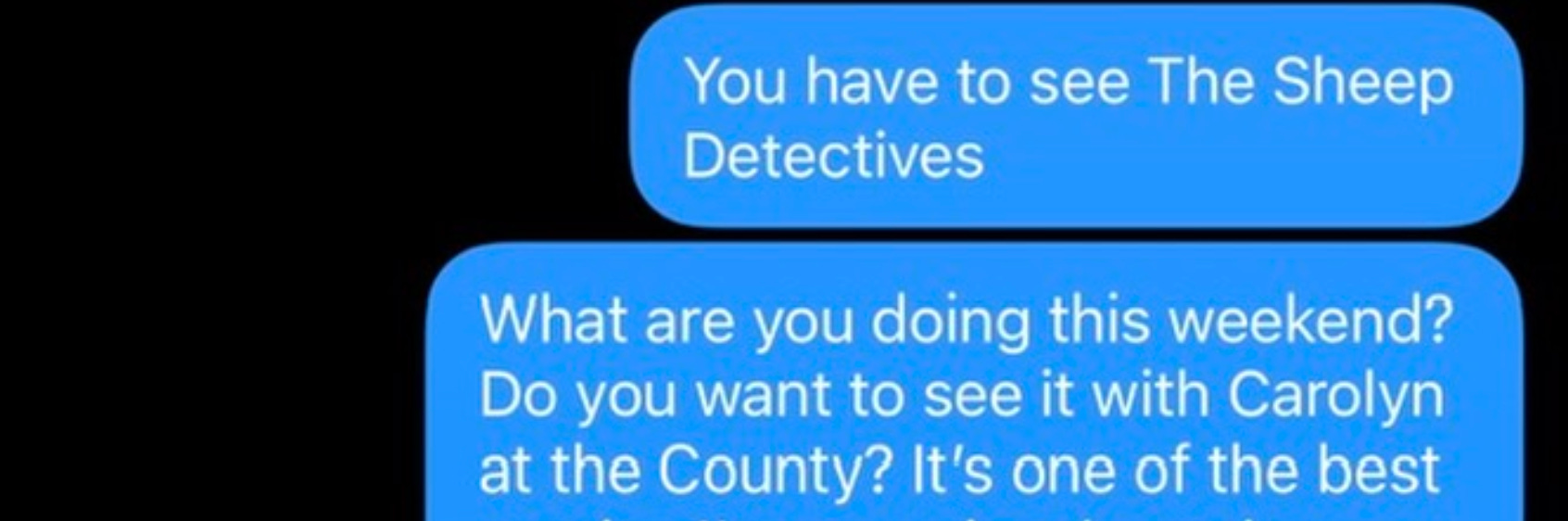
Please watch The Sheep Detectives

This post was scheduled to go out next week, but I’m in Vermont visiting family and friends, many of whom are writers and educators. Our conversations have centered around creativity and AI and how we’re all adapting (or revolting against) this changing world, and it felt like the right time to hit post.
This one’s for you, G.
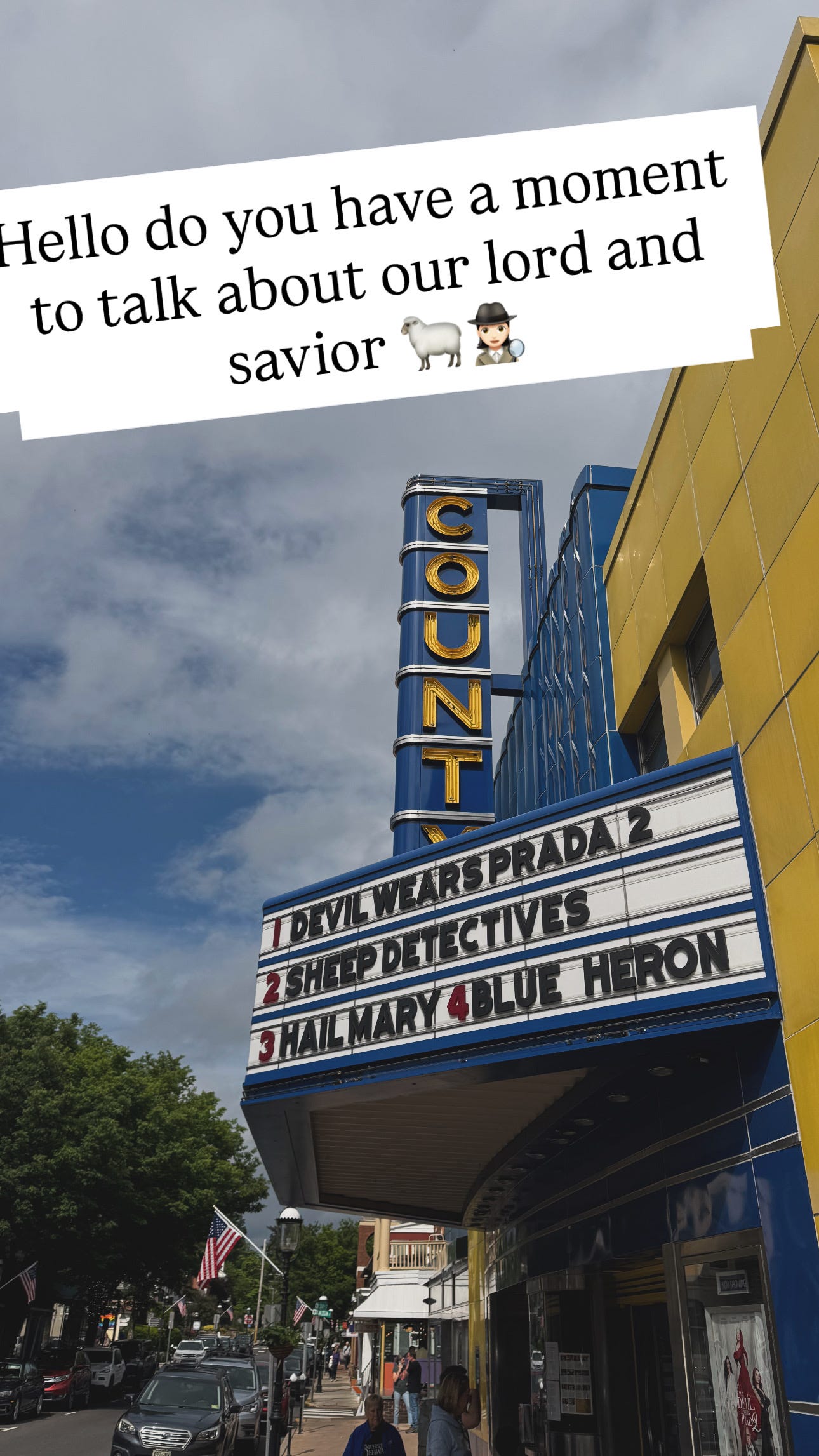
When The Sheep Detectives released in theaters, I went to see it thrice in one month. I became the movie’s unofficial evangelist: I bought bulk tickets for showings at my local indie theater, collected skeptics, and shepherded them to midday matinees and evening screenings. Almost no one in my life was willing to see it. My texts were met with a dreaded deflection: pass, but let me know how it is! Nevermind the stacked cast– no one could get past the admittedly bizarre premise of CGI sheep solving a small-town murder mystery. But I am loud about the art I love, and I’ve made it my business to get it in front of my people.
My last viewing was with a group of friends who have never read a mystery in their lives and who I bribed to the film with a promise of a full ride to the concession stand. As the movie blazed into its final third, our entire row was a cacophony of sniffling; every one of my friends was sobbing into their popcorn buckets. We all left the theater wiping salty tear tracks from our cheeks. I was so happy.
“I feel like I got hit by a train,” one friend said. “What the hell was that? I was not prepared.” Not prepared. Some might even say bamboozled by the talking sheep murder mystery. What a delightful feeling! I was thrilled for my friend, who went into the movie skeptical and came out moved, maybe even transformed.
Driving home from the theater, I kept thinking: someone made that. Someone pitched a talking-sheep murder mystery book adaptation with a genuine emotional core, and someone else with money said yes, do it, and a whole team of people poured themselves into it, and now my friends spent their evening crying into their popcorn buckets over a CGI cloud. Better still that the movie was written by Craig Mazin, whose range is truly unmatched— he’s the mastermind behind The Last of Us…and also Scary Movie 3 and 4. Big swings all around.
That range of creativity, and that chain of events– the bet, the swing, the landing– is something I am hungry for, as an audience member and also as a person who makes things for a living.
I think about creative risk constantly: what it takes to attempt something new, what it costs when it flops, what it feels like when you watch someone else pull it off. My career relies on the quality of my ideas and my ability to deliver on them. But before that can happen, before the query or the pitch or the proposal, there has to be permission given from me to me to pursue whatever strange idea has come into my mind. That permission is not something I can give myself in a vacuum; I need to see other people doing it. When I watched The Sheep Detectives and felt that jolt of I can’t believe this exists and it’s this good, part of what I felt was relief— thank god for the world’s wild ideas. Big creative swings entertain us, and they also give us permission to think differently, to reach further with our own work than we otherwise might.
I fear we’re living through a crisis of creative risk thanks to optimization culture and algorithms and fear around financial losses. The world is moving toward a reality that is largely designed and governed by algorithms, and algorithms run on consumption data: using what you’ve already consumed to predict what you’ll want next. Output mirrors input: feed yourself a loop of what you already know you like and you eventually produce a slightly optimized version of what already exists, which is why I’ve deleted most algorithm-fueled apps from my phone.
Algorithms interpolate, but never originate. What they produce over time is a narrowing of perspective. Your existing preferences are confirmed, sharpened, and served back at higher resolution. The whole thing is a closed loop— what I watch and stream and finish becomes data. That data decides what gets recommended to me, and those same numbers, pooled across all of us, decide what gets funded next: what’s worth the bet and what isn’t. So what gets made drifts toward a tuned-up version of what already got watched, which becomes the only thing left to watch, which becomes the next round of data, which trains the next round of what gets made. Around and around, and the longer it runs, the smoother and surer of itself it gets. This is a problem when it shapes not just what gets recommended, but what gets made– and it does shape what gets made.
Take Heated Rivalry, some of the most fun I’ve had watching TV in a long while. In the wake of its success, we’re being pummeled with hockey romance books, hockey romance shows, hockey romance promotional material. But Heated Rivalry didn’t ride a hockey trend— in fact, there is minimal hockey in the queer hockey show. It was successful because it felt new. It took a familiar story (romance) and infused it with some special sauce that made it pop. The lesson shouldn’t be make more hockey content…but somehow that is what it has become.
Dan Levy, during an episode of Elizabeth Day’s How to Fail podcast, talked about this when trying to get Schitt’s Creek made; how every network passed, saying only that based on the premise, their audiences wouldn’t go for it. Schitt’s Creek went on to sweep the Emmys in a historic run that made those passes look like the collective failure of nerve that they were. The shrug-off of “audiences won’t go for it” was a guess about future taste assembled out of past behavior; the algorithm, only ever able to look back, and never ahead. Levy emphasized that audiences don’t know what they want until they see it.
You cannot survey existing preference or feed content to DaddyAlgorithm and arrive at a show like Schitt’s Creek (or Heated Rivalry.) You can only bet on it when it comes across your desk. It’s a risk. But when engagement data and predictive modeling become the criteria a green light committee uses, that bet becomes harder and harder to make, and when the bet doesn’t get made— when the network or the publisher passes on a book or a show that doesn’t quite line up with what their readers and viewers have consumed in the past— we all lose something; not just shows and books and movies, but the expansion of imagination that comes from watching someone do something fresh and exciting.
Publishing runs the same machinery. Writers querying agents are expected to arrive with comp titles: a curated list of recent releases their book would sit between on a shelf, shorthand for where it belongs in the marketplace. A comp is a recommendation engine in human form– if you liked these, you’ll like this– and to have no comps is, we’re told, a massive red flag. There’s a reasonable logic to it, but there’s also a meaningful distance between acknowledging what your work comes from and reducing it to a crossover pitch. The book that resists positioning, that maybe has no comps because it’s attempting something the existing titles haven’t accounted for yet are most likely to be the freshest creative endeavors. They’re also the ones the system is least equipped to green-light.
When I’m feeling particularly down about the viability of my projects, when I get another thanks but pass from an editor, I watch a video from the 2009 White House Poetry Slam. Lin-Manuel Miranda stood in front of God, America, and The Obamas and announced he was working on “a concept album about the life of someone I think embodies hip-hop: Treasury Secretary Alexander Hamilton.” Warm laughter rolled across the room, which Miranda meets with an impassioned, “You laugh, but it’s true!” I’ve watched that clip more times than I can count. It reminds me that the most transformative work can sound, in summary, like a joke.
My creative path is littered with the influence of other artists’ big creative swings: Oh Mary!, Cole Escola’s uncategorizable chaos play about Mary Todd Lincoln. Heated Rivalry. Amy Winehouse’s music. All of them, big creative swings that keep my mind alive and working because they are fresh, authentic, and exist entirely outside the parameters of what could be predicted or designed. They are evidence that the collective imagination is still capable of surprising itself.
I try my best not to share too much of the premise of anything I recommend to people. Hand someone a premise and you hand them a hedge. I’ve pressed copies of Emma Straub’s This Time Tomorrow into friends’ hands even as they insist they’re not really into “time travel books.” Same with Stephen Rowley’s Take Me With You, to people who “aren’t into alien abduction stories.” “Just try it,” I say, “it’s not what you think.”
I’ve watched creators hedge themselves out of their own best ideas before anyone else got the chance to say no under the guise of “writing toward the market.” We are being conditioned to do the gatekeepers’ work for them, preemptively sanding down the weird edges of our ideas to make them more pitchable, more comparable. Every time a creator self-edits before the idea has a chance to breathe, we all pay for it.
Creativity isn’t a private act, but a commons. What gets made shapes what the rest of us believe is possible to make. I need other creators to take big swings so I don’t forget to take my own. The sheep murder mysteries and the Treasury Secretary hip-hop musicals and the queer hockey romances and the Mary Todd Lincoln chaos plays are proof that the biggest, most unclassifiable idea in my notebook is not disqualified by its strangeness.
Creativity is a collective good. We need it not just to entertain each other but to help one another think. My friends all left the theater crying after seeing The Sheep Detectives because the movie delivers emotional punches, but also because their guard was down when they went in, and they were open to receiving something unexpected. That’s the reason I keep making things, and it isn’t something we can optimize our way toward.
I finally watched The Sheep Detectives and it was so good! Love this ❤️
We watched the sheep the other night and loved it as well! Admittedly a surprise. Here’s to taking risks and staying true to the vision. It’s something I struggle with sometimes, so i appreciate the reminder!!